Indigo Jo Blogs

Subscribe to Indigo Jo Blogs feed
Politics, tech and media issues from a Muslim perspective
Updated: 8 hours 4 min ago

A past that we know was never real

22 February, 2026 - 22:44
A still from a Restore Britain video. It shows a man standing in front of a four-bar farm gate, looking out onto green fields. The words "National Restoration" and in larger type "Restore Britain" (Restore misspelled with a Q instead of an O) are superimposed on the image.

Rupert Lowe, the MP for Great Yarmouth elected on a Reform UK slate in 2024 who subsequently went independent because his views on immigration were too extreme even for Nigel Farage, has now formed his own party, Restore Britain. Its policies include abolishing the BBC licence fee, abolishing inheritance tax, abolishing hosepipe bans (cutting immigration is meant to help with that), restricting postal voting, “restoring” the British pub and the High Street (by clamping down on immigrant associated businesses such as barber shops), abolishing foreign aid and the mass deportation of not only illegal migrants but also legal immigrants who they regard as unproductive or burdensome, and the removal of “COVID relics” and the annulment of convictions for breaking lockdown rules incurred during “the darkest time in recent British history, a time where our freedoms were trampled over all in the name of bent ‘science’”. They have not, so far, scored any defections by MPs but a few councillors have defected and some local activists previously associated with Reform, such as the leader of the “Pink Ladies” Orla Minihane (who a few weeks ago told us she wasn’t going to run for a council seat for Reform but dedicate herself to her new Rhiannon Whyte Foundation, named after a worker in a migrant hotel who was murdered by one of its residents; now we know why).

The party and its sole MP have been putting out lots of videos, mostly of Lowe giving speeches and attacking Nigel Farage more than any other single politician. There’s a video of Nigel Farage apparently backtracking on one policy statement and then another, with The Who’s song “Won’t Get Fooled Again” as a backing track (not sure if Pete Townshend’s lawyers are onto it). Another is titled “National Restoration” and consists of a flickering array of old images of 20th-century England: steam trains, ladies in floral prints walking in pretty streets of small towns and sitting down to tea, red squirrels, the cliffs of Dover, RT buses, military band performances. “In 1997, Britain was in good shape,” the voice-over informs us. “We knew who we were, we were still one country; most importantly, the population was stable and immigration was under control.” 1997? Oh yes, the year Tony Blair was elected and eighteen years of Tory government ended. If Rupert Lowe likes Tory government so much, why doesn’t he just become a Tory? But the mention of 1997 makes all the images absurd. AEC Regent or RT buses were a London Transport mainstay from World War II through to the 60s which was finally withdrawn from service in 1979, the year Margaret Thatcher first came to power; the route shown, number 152, had last used that type of bus in 1970. Red squirrels were as rare in most of England in 1997 as they are now. Steam trains only ran on preserved lines, as now. You don’t see too many women dressed quite like those in RB’s clips in 2024, but fashions change.

I remember 1997. I was 20 that year. Labour won the election with a landslide and pro-European, progressive parties won a very comfortable majority of the popular vote, with the Tories reduced to 30.6% and wiped out in Wales and Scotland. There was much demand for self-rule from both Wales and Scotland and for peace in Northern Ireland, which everyone knew would not be achieved with permanent direct rule. Immigration had been reduced since the late 1960s, but it was still possible to bring spouses very easily from the “New Commonwealth” countries such as India and Pakistan and many did; the 2001 Oldham riots and the terrorist attacks that year led to spousal migration being restricted so that anyone not making a good salary was excluded (Lowe’s policies include an end to this for countries not included on his “red list”). The Tories were widely derided, were hopelessly divided over Europe with the prime minister calling some of his own cabinet ‘bastards’ and reported as threatening to “f**king crucify” others; they had a reputation for meanness, imposing VAT on domestic fuel in breach of their manifesto, and attacking single mothers from the conference podium (at the time, the electronic dance band The Prodigy released a single called “Smack My Bitch Up”, which caused much controversy as you might guess; a BBC radio comedy show quoted a politician as saying the title was acceptable as it referred to a single mother).

The Blair dream went sour in his second term, but in 1997 there was a lot of optimism and joy at the result. There’s nothing to be optimistic about from Lowe’s pronouncements. Like Farage before him, he blames immigration for everything. Just today, he posted a rant about litter by the side of Britain’s motorways, moaning that “our country is increasingly becoming a third world dump”, and then proclaiming that his government will put “healthy Brits who consistently refuse work” out to work cleaning it up (this is actually a job we currently pay people for) and that there would be “no foreigners on benefits” under his rule either. Elsewhere on his Twitter feed, he has a side-swipe at “the healthy British shirking class”. In another one-minute video posted on Twitter, he tells people who “don’t want to work” not to vote for him and rails against doctors signing people off work on “sick notes” because of headaches and other trivialities, against a backdrop of what looks like 50s London. All just recycled prejudices culled from Sun editorials and Tory party conference speeches.

Restore Britain is a backward- and inward-looking party that appeals to the same people who produce nostalgia videos about the once-great British high street, back when everyone was white and men were men and women were women. Lowe has gained much publicity from his unofficial “rape gang inquiry” over the past few weeks, but in truth he does not care much for the British working class: he proclaims in the 1997 video that “the individual is good, the state is bad” (except when it’s rounding up and deporting people, of course). Restore might not be a neo-Nazi party as it doesn’t have that heritage (although it has attracted a few supporters from that quarter), but he is still a politician that appeals to bigotry while romanticising a past that was never real, offering policies that will leave most people worse off.

2010: Looking back in anger

21 February, 2026 - 15:22
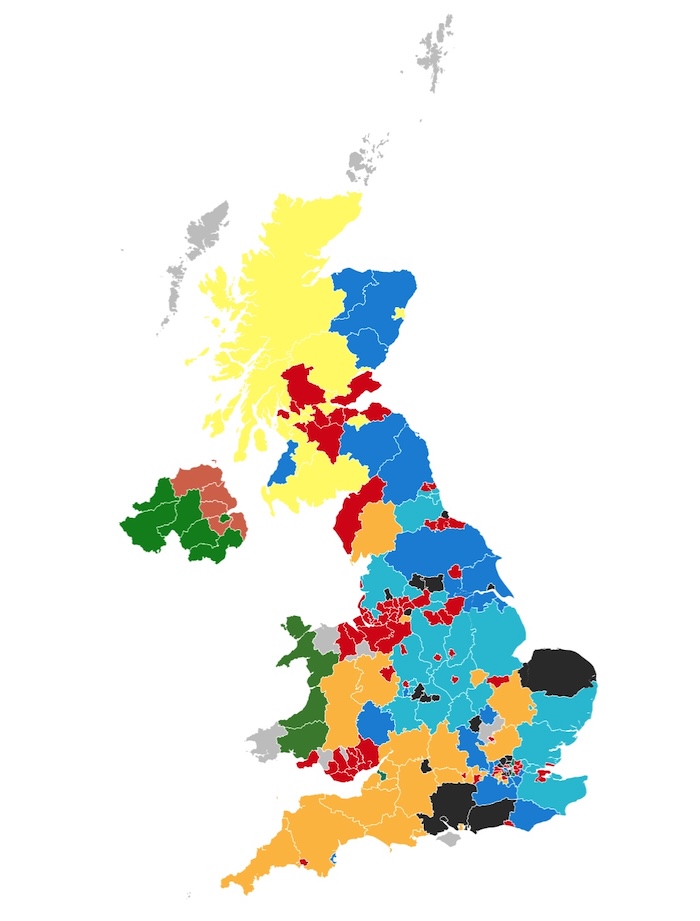
A colour-coded map of the results of the 2010 UK general election.

There’s a certain type of politician and political activist who is quick to take credit when his party wins, but will blame everyone but himself and his allies when they lose, and can be very inventive in doing so. In the aftermath of the 2015 election, when the Liberal Democrats lost many of their seats both in the affluent suburbs and the rural south-west where they were the major exception to the Labour/Tory two-party politics of the rest of England, the theory was put about that they lost so many seats because the public had been warned by the Tories of the danger of a Labour/SNP coalition in the event of a hung parliament (i.e. one with no party majority), anything but admit that their conduct during the coalition government had angered many of their former supporters and that many of the others actually wanted the promised referendum on EU membership. The other day, I came across an article on the previous election, in 2010, in which Labour lost power and were replaced by that Tory/Liberal coalition which implemented austerity measures so as to quickly pay back the debts the previous government had incurred while bailing out banks to ensure that people did not lose their savings, while also sneaking through some tax cuts so that a future Labour government could not reverse them. The blog article blamed the Guardian for endorsing the Lib Dems and the intellectual Left for voting for them instead of Labour.

A brief look at election maps of the 2010 and 2005 elections will show that Labour lost considerably more seats to the Tories than they did to the Lib Dems (though they did lose a few, such as Norwich South). In 2005 there was a swathe of red on the map running eastwards from north Wales to the Humber estuary, taking in all of the urban areas of Yorkshire and Lancashire; in 2010, there were two, smaller, separate red sections. The “Red Wall” had already started to fragment. Labour also lost a swathe of seats running southwards from the Pennines down to the Midlands, which we might call the “Red Column”, to the Tories as well as a number of seats in the Thames estuary and the large towns (as opposed to cities) of the south, the Midlands and East Anglia. The Lib Dems, although they increased their voter share by around 1%, actually lost five seats (this is an estimate, as electoral boundaries had changed). Labour’s vote in the north Midlands was reduced to just the urban areas, while the urban islands further south disappeared.  This could not have been down to a Guardian editorial; the decision of the Sun newspaper to switch its support to the Tories would have been more significant, but there is no reflection on why Labour lost so much support in this part of the country.

Labour’s strategy in the late 90s was to target the same voters who had defected to Thatcher’s Tories in 1979 and after: lower-middle class or ‘C2’ voters, as well as voters in the Midlands and those from working-class backgrounds in places like Essex who had moved beyond the cities as their circumstances improved. The theory of the time was that for Labour, the classes above C2 (meaning the wealthy and salaried professionals, classes A to C1) will never vote Labour in large numbers while those below (D and E) always will, so need not be targeted. To target the working class was seen as electoral suicide; people who talked of it were perceived as Scargillites or dinosaurs. Blair’s government was influenced by the now disgraced (and always regarded with much suspicion) Peter Mandelson, who early on in the Blair government told Peter Hain, a minister of state in early Blair cabinets and a cabinet minister later, that the working class had nowhere else to go. A little over twenty years later, that same working class sent Boris Johnson back into Downing Street with a substantial majority. A major contributory factor may have been Blair’s decision to allow migration of workers from eastern Europe into the UK in 2004, when other EU countries did not, as was the norm when weaker economies joined the union. I have written about the effect this had on the labour market in the UK at the time and it was not as simple as “they’re taking our jobs”: a ready supply of migrant workers frees employers from having to invest in or take risks on local talent, and when many of them are not setting up homes here but living in rooms and sending money home, they will not demand wages appropriate for living and raising a family in the UK. Academics like to stick their fingers in their ears and talk of the “lump of labour fallacy”, but in a country with a labour market as loosely regulated as ours is, a buyer’s market does not favour the working class.

Blair won a landslide in 1997 and a respectable majority in 2001 on a pro-European and pro-Maastricht platform. Leaving the EU was lunatic fringe politics at that time; Labour had lost elections it fought on the pledge of leaving the EEC in the 1980s. By 2010, the Tories could gain the largest share of the vote and by 2015 a majority on the basis of a pledge for an EU referendum in their manifesto. As they were in coalition with the Lib Dems in the 2010 parliament, they could not deliver it as the Lib Dems were opposed; they finally did in 2016. The 2015 election and Labour’s performance is often judged as Miliband’s failure — either by running on an “old left” platform or being too indistinguishable from the Tories — but the 2016 referendum result shows otherwise: that was a Brexit election, and Tony Blair had lost it in 2004 before Ed Miliband ever ran for leadership. It is possible that, had the Tories won a majority in 2010 and held the referendum a few years earlier, maybe in the afterglow of the 2012 Olympics, the result would have gone the other way, but we can only speculate. The Lib Dems in coalition only postponed the inevitable as regards the EU referendum and did little to mitigate the Tories’ austerity drive.

The Blairite faction has a tendency to take the credit for Labour’s wins when they are in charge, but blame everyone else (and especially the Left) for the losses (if one of theirs loses, as with Gordon Brown and Ed Miliband, he will be accused of tacking too far left). They assume Blair won because he was Tony Blair, and because he alone knew what had to be done, and ignore the factors in his favour, particularly the constant scandals that afflict late-term Tory governments and the Tory vote being split with a hardline anti-Europe faction such as the Referendum Party, Brexit Party or Reform UK; they also ignore the fact that his actions led to a dramatic loss in the party’s fortunes in their third term which the new leadership failed to put right after Blair got out before his mess hit the fan. The 2005 result, where Labour won a majority off 35.2% of the popular vote, should have been a wake-up call, but it was not heeded and the party let Gordon Brown run unopposed for the leadership as if he had a right to it (when you point out that Blair won this election by the skin of his teeth, his fans simply counter “he won”). They are also as messianic and blind to their leaders’ faults as the Corbyn cult were to their leader’s: they mistake cowardice and meanness for wisdom and they trivialise major mistakes, even crimes: our involvement with the Iraq war in Blair’s case, the collusion in the Gaza genocide in Starmer’s. They expect lifelong Labour supporters to just accept this as the cost of winning. They expect whole sections of society to just accept getting shafted for the same reason, because they’re not as important as another group of people whose votes they need, whether it’s the old working class under Blair or Muslims under Starmer, and are shocked and angry when there is no acceptance.

There is also a tendency towards superstitious reasoning. This also affects Democrat supporters in the US. The previous two times a Labour party went into an election in government but with a different prime minister to the elected one, Labour lost, they say, so Labour should just get behind Starmer despite such things as the party’s persistent low opinion poll ratings, sometimes well below 20% with Reform UK polling over 30%. Labour have never actually ousted a sitting prime minister; Harold Wilson resigned of his own accord in 1976, and Blair in 2007 having stated in 2004 that he would not seek a fourth term, i.e. contest an election in 2009 or 2010. I heard the same reasoning from the late Victoria Brownworth, a Democrat-supporting journalist in the US, about whether Joe Biden should have stood down as candidate on account of his failing mental state during his presidency: the last time a Democratic president declined to stand for a second term (Lyndon Johnson in 1968), his successor lost, as did Kamala Harris, Biden’s vice-president who succeeded him as candidate. That’s two occasions each in each country. There just aren’t enough cases to establish a pattern; James Callaghan and Gordon Brown served three years each and failed to be re-elected for different reasons.

Labour are a year and a half into a five year term; they have all that time to give people a reason to vote Labour in 2029. Mid-term blues are not a new thing but Labour or the Tories continually scoring 21% or less definitely is. It could be that the Reform vote will tear itself apart come 2029 as Restore Britain absorbs much of the racist vote that previously went to Farage’s party, but that is not a risk Labour can take. Labour must understand that if they do not cater to people’s needs, Reform or Restore Britain will cater to their prejudices while their “thinking vote” will not show up if there is any alternative and sometimes even where there is none. There is a sense that we expect better of the Labour party: this sentiment was heard often during the antisemitism debate, and should be heard louder in any debate on the Government’s support for Israel during its genocide in Gaza and its repression towards those who oppose it here. We also do not vote Labour expecting swingeing cuts to disability benefits or special educational needs and disability (SEND) provision in schools. The prospect of a far-right government led by Nigel Farage, let alone Rupert Lowe, off 30% of the vote because of the legacy parties’ unpopularity is a dire one; the leaders will get by on law work, public speaking and think tanks, while ordinary people suffer. If Keir Starmer cannot take this on, he should step aside and leave the job to someone who can; if the party continues to perform poorly in local elections and by-elections, it must take the initiative before it is too late; if you go into the next election and poll the predicted 19% to Farage’s 30%, you will not have the Left or the Guardian to blame.

We don’t all know each other

15 February, 2026 - 17:45
Picture of Rupert Lowe, a middle-aged white man, standing in a field in a rural location with a small stream behind him.Rupert Lowe

The grooming gangs issue has been all over social media the past few weeks: three weeks ago, a group called Open Justice UK published the transcripts of the 2019 Bradford trial in which nine men, eight Asian and one white, were handed lengthy sentences (all but two received between 16 and 20 years) and promised a three-part podcast in which one of the two victims, Fiona Goddard, gave an interview about her experiences to the feminist campaigner and writer Julie Bindel. That was “next week” three weeks ago and finally appeared on Wednesday (on YouTube and other podcast platforms). In the meantime I went down something of a rabbit hole, looking for podcasts on the issue to listen to as I drove around the south-east delivering flooring products, and stumbled upon a couple of interviews with one Raja Miah, a former adviser to Tony Blair on counter-extremism who was accusing all and sundry in the Labour party especially of complicity with the gangs in a search for votes. This week, in response to some testimony given at the “Rape Gang Inquiry” being chaired by the Reform splinter group MP Rupert Lowe (right), there was an exchange on GB News alleging that British Muslims would rape “working-class white girls” for Eid; a racist Twitter account called “Britain is Broken” shared it with the words “In the UK, evidence is mounting that suggests Muslims spend Eid by inviting their families round to rape little white girls”, subsequently shared by GB News correspondent, Patrick Christys.

I did some digging for information on Raja Miah and it turns out that he has an axe to grind: he ran two free schools which failed and was secretly blacklisted from further involvement in education. He makes wild accusations against local Labour MPs and councillors and when inquiries do not support his claims, he calls them a whitewash. On one of the podcasts, he claimed that Axel Rudukabana, the teenager who carried out the triple stabbing in Southport that sparked the 2024 race riots, was an Islamist and the fact that he had ricin, a poison used in past assassinations and which has become associated with terrorism, proves it; in fact, the precursors for ricin, such as castor oil beans and the plant that produces them, are readily available and Rudukabana had a long history of violent behaviour at school, going back to his early teens, was obsessed with violence and was not Muslim at all. He accuses Labour politicians of collusion in postal vote fraud, and rails against what he calls sectarian candidates for parliament, but fails to consider that much postal vote fraud was intended to prevent young people voting for precisely these candidates, and during the Blair years, for candidates such as George Galloway and Salma Yaqoub. This is not a very rational individual. However, he did make one useful observation, which was that the ‘Pakistani’ grooming gangs nearly all traced back to around three villages in the Mirpur area of Azad Kashmir and were basically one big family. This is not a problem endemic in the entire Muslim community; its core is a criminal element in a sub-group of a sub-group. Racists commonly allege that the gang members are of “Pakistani ethnicity”; anyone who knows anything about Pakistan knows that there is no such thing. It is just a category used in British bureaucracy, for statistics, diversity monitoring and so on.

There is a widespread assumption that the Muslim community as a whole is responsible because it sheltered the abusers or failed to turn them in to the police. “There isn’t enough said about how SHAMEFUL the Islamic community in the UK is for shielding their men who r*ped and groomed British girls,” proclaimed the Australian “writer/artist” Alexandra Marshall. Everyone knew, she alleges, from their wives to the neighbours to the mosques and community leaders. This is simply not true: the Muslim community is spread across the country, is very diverse, featuring people whose origins are all over the world, not just in Pakistan or even south Asia but also the Middle East, Africa and Europe itself, including the UK. We do not all know what is going on in towns 150 miles or more away, and even if we are aware of something untoward happening, that does not mean we know exactly what, or who is involved. Not every minority group, whether it’s religious, ethnic or (say) disability-based, is so close-knit that everyone knows each other, as people outside them often assume.

There is, however, plenty of evidence that both police and social services, care home staff and other authorities knew already, turning a blind eye because they regarded the victims as ‘difficult’, “their own worst enemies”, “child prostitutes” and various other victim-blaming descriptions. The police “locker-room culture” in which women are assumed to be asking for it or to be unreliable witnesses, and which protects officers who abuse their partners or colleagues, is well-known; let’s not forget that one of the police forces in Yorkshire preferred to believe a tape with a man’s voice on it than women who said their attacker was local and missed many opportunities to catch the Yorkshire Ripper earlier. Fiona Goddard mentioned that the police arrested her and let one of her abusers get away, and that care home staff knew she was missing for days and shut her out when she came back drunk. The system did not, and does not, allow care staff to physically prevent children from going out even if they are known to be at risk of exploitation or abuse unless the home is a registered secure home, of which there are only 14 in the country (only one, in Peterborough, is just for girls), and there have been accounts on Twitter from people who worked in such places that they had to let the girls go because it would have been illegal to prevent them. Of course, some people who run away are fleeing abusive situations, but there needs to be a way to protect girls from this type of abuse and right now there is none.

As for the accusations of “Eid rape” made on GB News, that little cabal are pretending not to understand why that claim is racist, and indeed dangerous. The reason is that it was phrased, both in the TV clip and in the tweet from a third party, shared by one of the participants, in such a way as to imply that this behaviour is normal for Muslims in the UK — that we get together to rape young white working-class girls, rather than going to the mosque or the open-air prayer in the morning then home for a family meal in the afternoon, which is what we actually do. I’m sure they’ve heard of the blood libel, because the phrase is bandied around whenever war crimes by the Israelis are documented in Gaza; the actual blood libel started when a boy was found murdered in a Jewish quarter in England, and a myth was spun that his blood had been used as a food ingredient on Passover. The crime of one, or maybe a small group, or maybe as in this case a criminal family and their scummy friends and clients, was assumed to be the practice of all. If anyone professes not to understand why this claim was racist, they are either racist themselves, or stupid, or both.

I’m not calling Fiona Goddard or any other victim of the grooming gangs a liar (though some of the racist politicians and hack journalists who have latched onto this story undoubtedly are), but the only people with any blame for this apart from the perpetrators themselves are the politicians, councillors, police officers, social workers and others who allowed this to happen for several decades, leaving a trail of broken lives in numerous towns and cities, not because they were scared of being called racist but because they thought the same of the girls being abused that their abusers did. Lastly, anyone tempted to support Rupert Lowe’s new party imagining that they will usher in misogyny-free new age should read the words of his candidate in the upcoming Gorton and Denton by-election, Nick Buckley MBE:

Many British young women are wh*res but don’t realise they are. The days of morality & decorum are over. They make poor wives & poor mothers. They also contribute to the idea that all women are easy & can be abused.

On defunding or abolishing ICE

4 February, 2026 - 21:00
A street in Minneapolis where Somali women with metal trays of samosas are giving them out to protesters. An anti-ICE banner can be seen in the background.Somali women giving out samosas to anti-ICE protesters in Minneapolis (source: Mukhtar, X).

Imagine that there was a boarding school where children were being abused on a daily basis; where bullying was rife, where staff were casually physically violent and verbally abusive, where the food was routinely contaminated with such things as cigarette ash and insects; a school where petty rules stoked conflict and made life miserable, where staff were seemingly recruited by word of mouth at the pub and were neither vetted nor trained. Many people would say that this place should be shut down fairly swiftly, and that saving children from abuse was the important thing, more so than the concern that they may miss a few weeks of school. The benefits they get from going there do not justify the suffering.

Now consider that there is a police force that deals with a less than vital area of the law: in this case, immigration control and removal of illegal immigrants. Imagine that they act with extreme violence, that they do not distinguish between actual illegal immigrants and legal ones or even citizens but target anyone who “looks foreign”, abducting people to camps thousands of miles away for no valid reason, threaten and attack people who video their behaviour, and shoot people dead when they get in their way. Imagine also that they are deployed by the government against parts of the country which have a history of supporting the opposition, ignoring places that have many times the number of illegal immigrants of the places they terrorise. There would be calls for this entity to be abolished because the lawlessness they perpetrate is considerably worse than what they prevent.

A few weeks ago I saw someone I follow on Twitter, a Democrat who has a clear resentment for “the Left” for causing the loss of the most recent presidential election, poured scorn on the idea that ICE, the American immigration police responsible for an ongoing campaign of terror against immigrant communities in Minnesota, resulting in the deaths of two American citizens and seven others, should be abolished. “We need a sane immigration policy” she proclaims; “it makes no sense to import people into this country that dilute wages for the working class”. The reason working-class people cannot get good jobs anymore is because industry packed up and moved because it did not want to pay decent wages, which is the case both here and in the US, but it’s so much easier to blame immigrants in a country where the creed that you cannot argue with the market is beyond question. In previous tweets she has criticised people calling for ICE to be abolished because she claims they do not appreciate what “real Americans” want and are making it more difficult for Democrats to win elections. She does not actually care whether these things are right or wrong — a gang of thugs, terrorising cities, using extreme violence against non-violent people for nothing more than suspected illegal immigration — only whether it is politically convenient.

She also pours scorn on the notion of ‘defunding’ ICE. She criticises people for saying they are poorly trained, responding that to train them properly would require them to be better resourced. The same arguments are held around defunding police forces that are trigger-happy and have a history of killing innocent people, or at worst people who have committed petty crimes, or people who are in the throes of a mental health crisis; they have resources to buy wholly excessive and inappropriate military hardware to use on civilians, but have no interest in training their officers to use force appropriately. When you remind them of the need to do this, they tell you that they are not “social workers in uniform” (which is exactly what they do need to be when performing welfare checks on people reported to be in mental health crisis) and accuse people who died at the hands of the police of not doing what they were told. In the case of the ICE attack on Minneapolis, the police have become (at least for the time being) heroes, being firmly on the side of the locals under attack and some of their off-duty officers falling victim to ICE’s dragnet as anyone who is not white is assumed to be an illegal immigrant. But when people demand the abolition or defunding of police forces in response to yet another killing of an innocent man or woman by a cop who “didn’t have time for this shit” or whatever, they are called morons or similar by people who have no real solutions themselves.

Policing is actually necessary; the taking off the streets of rapists, murderers, gangsters and so on cannot wait. The removal of illegal immigrants certainly can, until they can find people who can do it without killing them, or innocent members of the public whom they perceive as being in their way, or people who were videoing them to hold them to account, and until they learn to distinguish between an actual illegal immigrant and a mere non-white person. If someone’s sole wrongdoing is being in the country or working illegally, their removal is not worth anyone losing their life over; it should not be up to the immigration service to apprehend and remove illegal immigrants who are violent criminals. They should be escorted to the airport straight from prison. A country that employs an army of undisciplined thugs who terrorise ethnic minorities and cities with a history of opposition to the government on the pretext of controlling immigration is a repressive country that is on the downslide into fascism or banana republic status and when such outfits are abolished when dictatorships are removed, the same people defending ICE would applaud. 

Who counts?

18 January, 2026 - 22:56
A man with a yellow and blue hat and no top on gives a Nazi salute from behind a crowd-control fence in a football stadium.A Maccabi Tel Aviv fan gives a Nazi salute at a match in Stuttgart, Germany

Last week the chief constable of West Midlands Police, Craig Guildford, retired after admitting presenting inaccurate information sourced from an artificial intelligence app, Microsoft CoPilot, in a report on the security situation that would ensue if the away fans of the Israeli football team, Maccabi Tel Aviv (MTA), were to be allowed to travel to Birmingham to see their team play Aston Villa. The information included mention of a fixture between MTA and West Ham, an east London side, which had never taken place. The mainstream media has been full of angry debate about who was a threat to whom in the event of the MTA fans coming; pro-Israel outlets and figures claim that the police, whom they claimed are under the sway of local ‘Islamists’, were underplaying the threat of local “Islamist thugs” to the Israeli fans while local MPs and Palestine supporters point to the club’s actual record of racist violence, both inside and outside Israel. In the event, the club withdrew the fans itself after a riot between their fans and another local team’s fans in Tel Aviv, but the latest revelations have prompted an orchestrated outrage from Zionists, securocrats and racists who claim that the MTA fans were blameless and that the opposition to them attending was motivated by antisemitism, or was antisemitic regardless of motive; this includes sections of the ‘official’ Left, notably including this sickening article by Gaby Hinsliff in the Guardian last Friday, who tells us that the affairs “stirs deep-seated fears” of being “obliged to retreat from mainstream spaces to spare everyone else the awkwardness of having to battle for their inclusion”.

How many times do we have to say that this is not about the right of Jews to walk any street they like, but about the ‘right’ of a group of foreign football supporters, most of whom have served in an army whose principal role is oppressing people, supporting violent settlers as they encroach on more and more native Palestinian land, and who have for the past two and a half years been slaughtering Palestinians in Gaza, to travel through the streets of Birmingham or indeed any other city in the UK where there is a large Muslim population? Let’s not forget that Russia has been excluded from international sport since its invasion of Ukraine in 2022, so there is no danger of its fans antagonising Polish or Ukrainian communities, and its war crimes, though still dreadful, do not approach genocide. Everyone who has been on a Palestine demonstration will know there are Jewish allies; you would not know who was Jewish and who was not unless they wore Haredi clothing and you do not know which of them supports Israel or not unless you ask or they tell. When it’s Jews who claim to feel threatened, of course, it’s another matter: when anti-genocide demonstrators wanted to demonstrate outside the BBC’s Broadcasting House on a Saturday, the day most people have off work, it was banned because there was a synagogue a few streets away. 

The same people expecting Birmingham’s Muslims to tolerate this complain constantly about “fighting-age males” from Muslim countries being offered asylum, accusing them without any evidence of being a stealth invasion. We have been told that the real threat was to the Israeli fans and came from “Islamist thugs”, a phenomenon unseen in this country and who went unnamed but no doubt referred to the potential for demonstrations: actual peaceful demonstrations against Israel’s genocide of the Palestinians of Gaza and its ongoing ethnic cleansing of the West Bank are referred to as “hate marches” while the media refers to actual thugs who stop aid reaching Gaza as ‘demonstrators’ or ‘protesters’. There has been outrage that the panel which selected Craig Guildford included an imam; it would, surely, have included other faith leaders as well. It was meant to represent the community and Muslims are a major part of the community in Birmingham. Matthew Goodwin (who until recently was a senior fellow of the UAE-funded Legatum Institute, which now trades as Prosperity Institute) lectures us that “Islamists” are starting to have influence, not bothering to distinguish between Muslims and “Islamists”; it is natural, in a democracy, that sections of the community have influence over decisions that affect their lives.

Jews do not have a right to be cosseted if they choose to throw in their lot with violent football hooligans and a foreign power that is oppressively and murderously racist. They deserve to be held accountable. Over the past several years, we have been lectured endlessly that their feelings are all-important, that they must feel safe and they alone have the right to dictate what constitutes antisemitism (and it must be the right kind of Jews, i.e. not dissenting ones). David Baddiel wrote an entire book called “Jews Don’t Count”, castigating the Left for failing to acknowledge Jews’ feelings of oppression or to count them among the oppressed, regardless of their whiteness in an age when that matters more than anything else, their ample access to media and to power; people who question their status as an oppressed minority stand to lose out, as Diane Abbott did in the years before the 2024 election. Meanwhile, a drumbeat campaign goes on to drive Muslims out of public life, which has now culminated in a senior police officer losing his job for failing to treat Muslims with the contempt they believe we deserve. Yes, he made some stupid mistakes, but none of these are the reason he was forced out. We all remember the quote about Islamophobia “passing the dinner-table test”; we are now entering an age in which it is less risky to be racist than not.

Hierarchitis

4 January, 2026 - 18:28
A sepia photograph of a young white man (wearing a dark suit and tie) and woman, with above-shoulder hair and a scooped neck top or dress.

Recently I listened to two BBC podcasts in the Crime Next Door strand. One was about the kidnapping of Lesley Whittle, the teenage daughter of a local bus company boss, in the mid 1970s by a notorious serial armed robber and killer named Donald Neilson and was found hanged in a storm drain under a public park; the other (Death on the Farm) was about a brother and sister, Griff and Patti Thomas (right), murdered in a farmhouse in west Wales around the same time, a death ruled a murder-suicide by the police, the coroner and the chapel pastor who refused them a church funeral, a verdict believed by none of her family and friends. In both cases, a senior detective was in charge who had the reputation for “always getting his man”; in the first, he had solved a number of murders but was new to investigating kidnappings for ransom (as, admittedly, was the whole profession), while in the second, it appears that he did not want to ruin a winning streak by being unable to solve a high-profile murder, so he jumped to the conclusion that it was a murder-suicide because there was no evidence of forced entry. These two stories reminded me of two more recent cases of a killer left to carry on killing or not apprehended as soon as he could have been because of a senior detective sold on a pet theory: the Yorkshire ripper case in the early 1980s, where the lead detective believed the killer was from another part of the country on the basis of a hoax and ignored (and aggressively rebuffed) leads that suggested a local culprit, and the White House Farm murders in which Jeremy Bamber murdered five members of his adoptive family and then tried to frame his adopted sister; the senior detective believed his story, and would only accept that he was wrong when other detectives proved to him that it was physically impossible for the sister to have killed herself with the rifle.

Last week Sue Marsh, a disability activist I came to know while campaigning against the Tory austerity programme of the early 2010s, published an article on her Substack about the culture she found while a patient at Addenbrookes hospital in Cambridge in the 90s and 2000s with Crohn’s disease, an obstructive bowel disorder. While the hospital carried out some pioneering research and some of its doctors were brilliant, there were also consultants who were sold on unscientific and irrational beliefs and treated patients cruelly on the basis of them, and because of the status of Addenbrookes and of Cambridge, what those consultants said and did became common practice. Ultimately the hospital was put in special measures because of botched operations and mistakes known as “never events” (i.e. they should never happen, such as the wrong part of someone’s body being operated on or removed or an instrument left inside them), and the health watchdog Monitor kept them under observation for 18 months, during which surgeries could not go ahead without them present. Even after this, however, doctors trained there at that time were appointed as consultants elsewhere, and good practice was replaced with bad (and cruel) practice learned at Addenbrooke’s. They were spreading like a hospital-acquired infection.

And Sue’s story about how the hierarchies in the health sector undermined good care reminded me of the tragedies and scandals in policing caused by the obsession with hierarchy at the expense of justice, human life or getting the job done (especially when that job was justice or saving lives). People are unable, or face punishment for, raising concerns; they are expected to address a superior officer meekly and always acknowledging their superiority; the superior rank is taken as proof of their being more experienced or better at their job, and though they may have experience, their rank may have had as much to do with impressing the right people at the right time or being in the right social clubs, or discrimination against a competitor because of their race or sex, or something else. Certain people, because of who they are, are assumed to know best, or they are assumed to be right because they were right in the past. In the case of the Pembrokeshire farm murders, the senior detective (DCS Pat Molloy) came from out of area, was a hero from having solved a triple murder in Staffordshire but knew nothing about the local culture and did not speak Welsh, but drew conclusions based on assumptions that anyone familiar with it could have put right, had he listened. All of these situations in policing happened in the 1970s and 80s; no doubt someone will say that this was years ago and the culture of CID has been reformed since and the Ripper disaster could not happen again, though the ongoing scandals about misogyny, domestic abuse by officers going unpunished and sex offences by police officers going unpunished until they kill someone suggests otherwise, at least in some forces.

Hierarchitis affects other institutions as well. For much of the 20th century, co-pilots on civilian airliners could not dissent from their captain, even when the captain was plainly wrong, and planes crashed and whole planeloads of people were lost as a result, because the captain’s mistake could not be challenged. In the book Longitude, Dava Sobel told the story of a naval officer who believed that the ship he was on was a long way from where his superior officer thought, and when he raised his concerns, he was shot for mutiny. The ship then wrecked, as he had said it would, and the surviving crew robbed, and the superior officer murdered. Hierarchies and chains of command are, of course, sometimes necessary and maintaining them in normal times conditions people to act on them when discipline is vital, as during war or a life-and-death situation such as the arrest of a dangerous, wanted criminal or the extinguishing of a big fire. Hierarchitis occurs where they result in bullying, the shouting-down of valid dissenting opinions, the wrong people being promoted and then assumed to be always right because of that promotion, with unjust or lethal consequences for junior staff, patients or the general public.

Badenoch and the know-nothing right

22 December, 2025 - 23:43
A march by women through a city street at night. A number of banners are held, most facing away from the camera, but one that is readable says "Girls just wanna walk home".

Last week, the government announced a new initiative to combat misogyny among young men, targeting both schoolchildren and teachers. The £20m programme will include training for teachers to “spot and tackle misogyny in the classroom” and on issues such as consent and the sharing of intimate images, behavioural programmes for “high-risk pupils” and a helpline for teenagers facing abuse in their relationships. £16m of the money is to be funded directly through taxation; the other £4m will, the government proposes, be raised from private philanthropy. There has been some criticism, such as from the Liberal Democrats who said that the effort would fail if it were not accompanied by efforts to “properly moderate online content”; the domestic abuse commissioner for England and Wales, Nicole Jacobs, said the commitments did not go far enough and that the ‘investment’ was too little. Kemi Badenoch, the Tory party leader, accused the government of spending the summer watching the drama Adolescence, about a boy who kills a girl in his class because she rejected him, and of coming up with “silly gimmicks”, calling for more police to be put on the streets (after her government spent 14 years closing police stations and running down the maintenance of those that remained) and for people to be removed who “shouldn’t be here, especially those from cultures where women are treated as third-class citizens” (her whole treatise can be found on Twitter here).

This was quite offensive to me because the type of violence these programmes are intended to prevent has affected my family, and the perpetrator was a white British man, not a member of an ethnic minority, not a Muslim, not a refugee and not an immigrant. Of the 117 women listed in Karen Ingala Smith’s census of women killed by men in 2019, 74 of the named perpetrators had a name consistent with being white British (and many of the others were European, e.g. Polish or Portuguese); in her 2024 list, the ratio was 72 out of 106. Some Muslim names do feature but the overwhelming majority were names consistent with a western or Christian background. (The perpetrator’s ethnicity is recorded only in a minority of cases.) So even if people who are Muslims, immigrants or both are overrepresented in statistics of certain types of sexual violence or of violence against women and girls, the majority of lethal violence against women is still carried out by the majority of the male population, i.e. white men. There has been much research showing that young boys are accessing pornography in their early teens or earlier as a result of gaining access to internet-enabled mobile phones, and that young men develop unhealthy attitudes to sex, believing that women enjoy things they really do not as a result of seeing them pretend to in these films. While it is true that the violence mostly comes from grown men or older teenagers, teaching young boys about the importance of respecting women and girls, of how to treat them properly in relationships and so on, is important, especially if they are going to remain our problem even if they offend because they are our people and cannot be deported. Even among Muslims, there is evidence that they are exposed to many of the same bad influences as boys from western backgrounds: pornography and the aggressive misogyny touted by the likes of Andrew Tate rather than old-fashioned attitudes imported from “back home”.

Femicide Census, the organisation founded by Karen Ingala-Smith to carry on the work started in “Counting Dead Women”, gave a partial welcome to the new initiative, though is critical of the stance that ‘femicide’ excludes partner or family-perpetrated killings. However, the group of feminists who have been loudly opposing transgender rights and self-indentification (Self ID) and have welcomed the Supreme Court ruling on the subject from earlier this year have been noticeably silent on Kemi Badenoch’s ridiculous remarks. I did a search of the Twitter accounts of some of the feminists known for this stance; only Karen Ingala Smith has tweeted anything critical of it (linking to an interview with the MP Jess Phillips). I did a search of the accounts @AjaTheEmpress, @JeanHatchet, @ForWomenScot (the organisation whose litigation led to the aforementioned Supreme Court ruling), @LilyLilyMaynard, @cwknews (Stephanie Davies-Arai), @HelenSaxby11, @HelenStaniland, @bindelj (Julie Bindel), @ripx4nutmeg, @jo_bartosch, @lascapigliata8 (Maja Bowen/Isidora Sanger) and @BluskyeAllison (Allison Bailey) for mention of Badenoch’s last name in the past week or so and I found none. In a couple of cases there was a link to an article by JK Rowling (who founded her own rape support centre in Edinburgh but whose last mention of Badenoch on Twitter was in April), distracting the discussion onto the trans issue. Many of these women have been using arguments about women’s safety in the trans debate and some have other histories of campaigning or at least opinionating about women’s safety, male violence and so on, so one would think they would be critical of a politician trying to slap down a serious effort to challenge violence against women with a stupid deflection onto race. Probably they would have been more than a couple of years ago.

Heartless and bigoted Tories are, of course, nothing new but by and large they were not stupid. This is. In 1975, the former editor of the New Statesman, Paul Johnson, wrote a piece for the magazine castigating what he called the “know-nothing Left” and the way the Labour party had abandoned the Left’s intellectual traditions and embraced the trade union movement: “the arrogant bosses of the TUC, with their faith in the big battalions and the zombie-weight of collective numbers, their contempt for the individual conscience, their invincible materialism, their blind and exclusive class-consciousness, their rejection of theory for pragmatism, their intolerance and their envious loathing of outstanding intellects” (my response to the piece, republished by the NS in 2013, is here). He noted that ‘elite’ and ‘elitist’ were used as insults, and would have readily have been hurled at major socialist intellectuals of the past including Aneurin Bevan. These days, though, we hear the word used most readily by the likes of Matthew Goodwin, who is regularly on TV accusing “elites” of betraying Britain’s popular will, whether it be on Brexit, immigration or anything else. Not billionaires and the politicians that do their bidding, but intellectuals. Right-wing writers and politicians have been fulminating against expert opposition to their demands for a long while: Michael Gove’s claim that the “public are sick of experts” springs to mind, but even back in the Blair/Brown years there was a piece by Melanie Philips proclaiming that the tabloid she wrote for represented the popular will, and it was quite right that the government listened to them (in this case, on the classification of cannabis) rather than to experts when forming policy. Traditional University arts subjects are run down year on year because of the belief that a college education is only good for building earning potential. As a result, we have an elite of uncultured ignoramuses, some of whom can barely string a sentence together (Suella Braverman springs to mind), who are contemptuous of anyone who knows more than they do.

Right now, the know-nothing Right aren’t in power in this country, but Badenoch’s brainless and bigoted response to a much-needed education programme to fight violence against women and girls should have produced a few critical responses from her own party. Ten or twenty years ago, it absolutely would have done. A Google News search reveals, in fact, no significant critical article bar one in the Guardian which quotes a couple of anti-VAWG charity figures; not that long ago, a chorus of disdain from the blogosphere would have accompanied a fair few mainstream media critiques. Someone ignorant enough to think misogyny and violence against women are imported problems, insignificant among the indigenous population, is just too stupid and ignorant to be in the running to be Prime Minister. I wonder if the party has anyone to replace her who has their head screwed on properly, or if the replacement is going to be just another frothing bigot.

Image source: Lajmmoore, via Wikimedia. Licensed under the Creative Commons Attribution-ShareAlike (BY-SA) 4.0 licence.

When a fallacy isn’t

20 December, 2025 - 12:52
 and you too"; below it are the words "Instead of addressing a criticism, the person points out your flaws to avoid accountability. Alleged hypocrisy doesn't invalidate truth".

Last weekend I saw a set of pictures on Instagram with the lead picture containing the headline “The Ten Most Dangerous Logical Fallacies”. The author, Sahil Bloom (author of a book called The Five Types of Wealth), does not explain why they are more dangerous than any other; these are just ten of the best-known or perhaps most common. They include ad hominem, straw man, appeal to authority, false dilemmas, hasty generalisations and the “fallacy fallacy”, i.e. thinking you’ve disproved someone’s argument because you’ve identified a fallacy. He also includes the “sunk cost fallacy”, continuing to expend money or effort on something because of the money or effort already expended, when “smart people” cut their losses; this is a major reason why scam victims continue to engage at their own loss after they start to suspect that they are being scammed, but it’s not relevant to the context in which the other fallacies listed are commonly used. However, the fallacy I want to discuss is “tu quoque” (“and you too”), also known as the “appeal to hypocrisy”, because it is often invoked in contexts in which the argument is in fact quite valid.

Tu quoque is illustrated by a man holding a bottle of beer, telling another man “you are not morally correct because you smoke”. The other man starts to reply “but …”. It’s a trivial example that illustrates how the fallacy works, but it also illustrates why it can sometimes be used validly. Smoking is something people often get addicted to when they are young, because their friends do it and they do it to fit in; tobacco smoke also smells bad to anyone not used to it and both the plant and the smoke contain chemicals which cause a number of diseases, mostly but not exclusively to the smoker. Many smokers nowadays do things to mitigate the effects to others, such as only smoking outside (it is banned in enclosed public spaces in the UK nowadays). Alcohol can also be harmful: it makes people drunk after a glass or two, often too drunk to drive safely, and affects their behaviour, making them uninhibited or violent. Western society considers a moderate drinker to be more “morally correct” than a smoker, but a hard drinker (including someone who might be found drinking at work, as that picture suggests) more of a danger. Someone applying for a sensitive job, such as a teacher, who was a smoker who only smoked outdoors would stand a better chance than a problem drinker, even though the drinker didn’t smell of smoke. (If drinking at all is a sin in your religion, as it is in mine, someone who is known to drink will be excluded from consideration altogether, and may be ostracised.)

And this last point illustrates why this line of argument often is no fallacy. It is a fallacy in a pure, academic moral exercise, but the world is not like that. In the real world, the accuser’s flaws might well be relevant. In an election campaign, for example, a candidate might be making loud criticisms of his opponent’s character but be just as guilty of some of them himself, or of others, and this would directly affect his competence or suitability for the job, so it is entirely valid for the opponent or his supporters to point it out. It might not make the thing he is accused of right, but if the accuser is worse, it might not make him a worse candidate. If a country is gearing up for war, criticisms of their enemy might include that he rigs elections, is corrupt, or is repressive and has people summarily executed or tortured, and the fact that other countries do the same does not make any of those things right either, but if some of those countries are our allies and we are not making any threats towards them, it clearly shows that human rights are not the reason for the war. Whether the war is justified or not, the debate needs to be had, and to be had honestly.

In other contexts, “tu quoque” fails as an argument. When someone is apprehended for a crime, it is no defence to argue that someone else has done the same, or worse, and is not being prosecuted. Sometimes this is fair, sometimes not; if the offence is drug possession, and the person arrested was arrested as a result of a racially-motivated stop and search while people with another skin colour use the same drugs freely, that is obviously unjust and racist, but if the offence is something that causes great harm, like rape, the unfairness is of no importance; taking one rapist off the streets is vital, even if it is in no way preferable to taking off two. It has sometimes been used as a defence in war crimes trials, where officials from the defeated power are tried at the behest of victors who have perpetrated other crimes in other wars, or in their colonial empires, but invariably rejected because the crimes in question were heinous and they were arrested when their attempt to seize their neighbours’ countries failed.

The same set of pictures includes a slide on the “appeal to authority” fallacy and this, too, sometimes has valid uses: 

The person uses an expert’s opinion as proof, without any supporting evidence. Experts can inform your thinking, but they generally shouldn’t replace it. People often hide behind credentials when logic runs out.

The problem here is that expert opinion is all that the average person has to go on when talking about things that are beyond their expertise. The average person might assume that one summer is the direct result of man-climate change, or that a cold winter disproves it; they often do not even know what constitutes ‘evidence’ and what is irrelevant. The fact is that the majority of the world’s climate scientists are of the opinion that man-made climate change, caused by burning too much fossil fuel too quickly while destroying the rainforests for logging and farming, is real; to state that is not a fallacy because the authority is real. What is a fallacy is when people cite dissenting studies to explain away a scientific consensus that is inconvenient to them, because it would require them to change their behaviour or might affect their business or other personal circumstances. They will often say “this scientist says …” or “this expert says …” without considering that he is the wrong type of scientist or expert, and is at variance with sometimes an overwhelming majority of qualified scholarly opinion.

In short, there are sometimes good reasons to use arguments that, in an academic context, are fallacies. Sometimes the character of one’s opponent is relevant, sometimes it matters that the accuser is just as guilty as the accused, sometimes it matters that the ‘offending’ behaviour is normal (though sometimes it does not), and sometimes we need to rely on experts rather than our own perceptions; even when the argument is not valid in itself, it does open a window on another injustice. We use arguments not for their own sake, but to advance a cause or to prevent harm being done. The world is not an academic exercise in moral philosophy, and we cannot and should not always behave as if it is.

Image source: Sahil Bloom, via Instagram.

Assisted dying and democratic niceties

14 December, 2025 - 22:41
Picture of Tanni Grey-Thompson, a white woman in her 50s with fair hair and glasses wearing dark blue trousers and a thick blue jacket, approaching an automatic ticket barrier in her wheelchair which is opening in front of her.Tanni Grey-Thompson testing out accessible rail travel in Liverpool

Currently in the UK, Parliament is debating a bill introduced by Kim Leadbeater, the sister of the assassinated Labour MP Jo Cox who was selected for the same seat after Cox’s successor was elected to a mayoralty, to legalise “assisted dying”, by which a doctor can administer or prescribe a lethal dose of a sedative to someone who has requested it because they are terminally ill and in intractable pain or have other chronically unpleasant symptoms. Currently, assisting a suicide is illegal, and while people who have assisted severely disabled relatives who cannot physically get hold of the necessary doses of whatever substance they intend to use are usually given suspended sentences (as with Kay Gilderdale in 2010), this still leaves them with a criminal record. This legislation goes further than simply decriminalising that act, but requires that a doctor be involved. With the House of Commons having waved the legislation through and refused a number of amendments intended to reduce the risk of unintended consequences, the bill has faced a lot of opposition in the House of Lords, an upper chamber nowadays mostly consisting of appointed “Life Peers”; there are also 26 Anglican bishops and archbishops (in the past, the house consisted mostly of hereditary peers, who were the holders of large historic estates — dukes, earls, viscounts, barons etc — who were overwhelmingly men, as well as a group of senior judges who are now part of the Supreme Court and no longer sit in the Lords). Some of the amendments proposed in the Lords are obviously unserious, and has led to a lot of chest-puffing in publications sympathetic to the bill, notably the New Statesman: who are the Lords to frustrate a bill that has been passed by the elected Commons? Don’t they know their place?

The House of Lords is entitled to scrutinise bills and can introduce amendments. Those amendments can, however, be voted down in the Commons and, when the bill was introduced by the government and the governing party opposes the amendments, they usually are voted down. Peers are appointed specifically to have diversity of backgrounds and life experiences, and some — far more than in the Commons — are not party-political (known as cross-benchers). Until the early 20th century, the House of Lords was dominated by the actual lords, wealthy men who were mostly very conservative, and they would vote down vital legislation such as those intended to settle the situation in Ireland. Their power to veto a bill altogether ended with the 1911 Parliament Act; all they are able to do now is to delay a bill becoming law by a year (the Liberal government achieved this by threatening a “mass creation” of Liberal peers after the lords had rejected budgets and Irish Home Rule bills). Convention dictates that the lords do not obstruct bills which were part of a governing party’s manifesto; the Leadbeater bill is a private member’s bill, albeit one tacitly supported by the government. However, the attempt to filibuster this bill has led to disapproval from some peers, including Michael Howard, the former Tory leader, as noted in the New Statesman last week, and outright scorn from the magazine and some of its letter writers; one this week called the debate “the sixth-form debating games in the House of Quangocrats” (referring to heads of arms-length administrative bodies) and another calling it “self-indulgence and sabotage of the popular will” and calling for the House of Lords to be abolished.

Filibusters of private members’ bills (prolonging debate so that it runs out of time) is nothing new; the Tory government in the mid-1990s of which Michael Howard was a part used amendments, the same tactic currently being used in the Lords, to talk out an anti-discrimination bill for disabled people. Also relevant to this is the attitude fostered towards disabled people since the party came to power in 2010: the widespread perception, promoted in the Tory popular press, that many disabled people are ‘scroungers’ and are claiming benefits they do not need and should not really be entitled to; this has continued since Labour returned to power this year, with a recent media storm about people using Motability, a charity that arranges leases of adapted cars using the Personal Independence Payment (PIP), which replaced the Disability Living Allowance during the 2010-15 Tory/Liberal Democrat coalition government, to buy posh German cars at state expense (in fact, the lessee must pay out of pocket if they want a more expensive car), and that many of those using the service have no worse disability than anxiety (in fact, someone with only anxiety would not get the mobility allowance necessary, if indeed any PIP at all). In short, it has come to be widely accepted that disabled people’s dignity and independence is an indulgence not worth the taxpayer’s expense, a phenomenon widely seen across the western world in recent years. It costs a lot less to prescribe a lethal dose of sedative than it does to provide a suitable wheelchair or to adapt someone’s flat so that they can live independently or semi-independently, and in countries where medically assisted suicide has been legalised, there have been many documented cases of people refused surgery or assistance for independent living but offered the lethal dose. In Canada the acronym is MAiD (medical assistance in dying), an old-fashioned word for a personal assistant.

As far as this being the “popular will” is concerned, the mere fact of it being that does not mean it should become law; parliamentarians are expected to exercise their judgement while debating laws that could easily have major consequences for many people; that is the principle of representative rather than direct democracy. The “popular will” in the last ten years resulted in us leaving a major trading bloc with no replacement, giving up rights for our children that we had enjoyed for two generations, and may yet see us give up further invaluable rights by leaving the European Convention on Human Rights. In this case, however, we are talking about a campaign among the political class which has gained the upper hand in the House of Commons which simply refuses to listen to sound arguments, including from much of the medical profession, from the palliative care sector, from disability rights advocates including Tanni Grey-Thompson, one of the peers whose amendment is among those ridiculed in the New Statesman recently, that it will put people’s lives at risk who do not want to die, or who might change their mind in time; it dismisses such objections as irrational, religiously-based, and stuck in the past. This bill has been widely condemned as poorly-drafted and lacking in safeguards, and if MPs had done their jobs properly, the Lords would have had less reason to filibuster it.

And let’s not forget, some of these MPs secured election on the back of quite a small share of their constituents’ votes: in our system, a candidate does not need to win an outright majority, and rarely do; it is possible to win a seat on a vote percentage in the low 30s if one’s opponents are sufficiently divided, and a share in the 40s is very common. Opinion polls currently predict Reform winning the next election, with a large majority, on the basis of around 25-30% of the popular vote. To give an extreme example, the current Labour member for South West Norfolk, Terry Jermy, who voted in favour of the Leadbeater bill, secured only 26.7% of his constituents’ votes, a result made possible by the division of the Tory vote (the seat was formerly held by Liz Truss) between the Tories and Reform. Kevin McKenna, MP for Sittingbourne and Sheppey in north Kent, gained his seat off a 29.1% share for the same reason, and also voted in favour of this bill. The New Statesman’s columnists and correspondents are indignant because, having thought there were enough people in the Commons who agreed with them (along with enough of the “great and the good”, including a Dimbleby in a recent edition), found that the Lords preferred to defend lives rather than defer to the personal views of people elected on minorities of the popular vote. For once, it is not sufficient to be popular; it looks like one might have to be right to get one’s wishes into law.

Why Farage’s teenage racism matters

7 December, 2025 - 15:59
An oil painting of Dulwich College, a large red-brick building with a small tower, behind a small lake with a tree to the left in yellowish autumn colour.Painting of Dulwich College by Camille Pissarro, 1871 (from Wikimedia)

Over the past few weeks there has been a series of revelations by people who were at school with Nigel Farage who was a pupil at Dulwich College, the prestigious private school in south London, between 1975 and 1982. The behaviours included persistent racial harassment of both Black and Jewish boys and putting a younger boy in detention while a prefect purely because of the colour of his skin. It had previously been reported that staff differed over whether to make him a prefect because of his clearly expressed racist attitudes, although the objections were overruled. The revelations have been met with contempt by Farage’s supporters, pointing to his young age, calling them pathetic and a sign that his opponents are scared but have nothing on Farage except accusations of childhood misdemeanours. If this were almost any other politician, they might be right, but it isn’t.

Farage was a prefect. Prefects at private schools are powerful; they are allowed to not only tell other pupils what to do, but also dish out punishments, a privilege rightly reserved for teachers in most state schools. At the petty private school I briefly attended in south London in the late 80s, we were told that prefects have “all the power of any of the masters (teachers)”. In not too distant times, prefects were allowed to beat younger children (at my later school, they were a law unto themselves and would punch, kick or beat up younger children in full view of staff). What these revelations show is that the last time Farage, who is tipped to be prime minister in three and a half years’ time, had power over other human beings, he used it to bully and humiliate them. Farage was also 18 at the time of at least some of these incidents. That’s an adult. I’ve written about the bullies at my school, including prefects, on this blog on many occasions in the past, but I’ve not named any of them (with one exception, a convicted sex offender) because they were kids, it was more than 30 years ago, and none of them is on the cusp of attaining any power. If they were, and all the signs showed that they had not changed a bit, I certainly would be naming them.

The other reason this matters is because of the sort of politician Farage is now. I listen to him rarely (never, if I can avoid it) but I did hear his performance on the 2015 general election hustings when he was leader of UKIP. On every single issue, he tried to divert it onto immigration. One issue after another, which after the second or third such incident elicited groans from the audience and finally, when the issue was AIDS, clear disgust and anger. Farage’s supporters also blame ‘immigrants’ (which include non-white British citizens) and immigration for everything, stereotype them as drug pushers and child rapists, call for people they consider to be immigrants or “not really British” to be deported at the drop of a hat, and make excuses for racist violence such as seen on the streets after the Southport murders. Always quick to point to white victims and sympathise with white anger; if it manifests in violence, it must be the victims’ fault, or some immigrant’s fault, never their own. This is the movement that threatens to take power in the UK (on the back of a small plurality of the vote, it must be emphasised) three years next May, if current trends continue.

If this was a politician who was now known for an anti-racist stance, or who at least was not known for racism or scapegoating or any other destructive or bullying behaviour as a teen or adult, I would agree that this was a smear campaign by his opponents, but if it was a Labour politician being ‘exposed’ in this way, the same people defending Farage now would be eagerly repeating the smears. What these revelations show is that Farage’s prejudices are lifelong, and that the likelihood of his becoming prime minister makes them, and him, a real danger.

Web services that suck

29 November, 2025 - 22:52
A picture of a laptop open on Facebook, sitting atop an open bin that is otherwise full of household rubbish.

At the tail end of the last millennium, before blogs and definitely before social media, there was a book published called Web Pages That Suck, a guide to badly-designed web pages aimed at people who want to design good websites. The author, Vincent Flanders, turned the concept into a website which he continued updating until 2015; the site now has clearly been abandoned, with lots of missing image markers and ads in every in-between space. Bad web pages were often full of animations and other material which distracted from the actual content, or the product someone was trying to sell. One website that really did suck was MySpace, an early social media contender, principally aimed at musicians (it allowed people to upload music for download) but used by lots of others as a networking site. It allowed users to make their pages as over-the-top as they liked and pages often had animations that made the text illegible and which took several minutes to load. It was taken over by Microsoft, which didn’t improve those matters until it was too late, and made it unfashionable in the era of the infamous bug-ridden Windows XP and processor-hogging Vista. It was crying out to be replaced and when Facebook came along, it was swiftly abandoned.

Last year a book was published by Cory Doctorow, former co-editor of Boing Boing and long-time advocate for online freedom as part of the Electronic Frontier Foundation and Open Rights Group, titled Enshittification (edited extract here; you can order the book from their bookshop). This book was a thesis about how online services that were (or appeared) good to begin with go bad as their owners try to monetise them. In the early days, the owners portray themselves as freedom-loving in contrast to their competitors (like Microsoft and MySpace) and offer exceptionally good deals to consumers by undercutting existing companies using their venture capital, but then betray their users by selling their data to commercial customers, then betray the latter by making it more and more difficult to sell their products and publications, imposing onerous fees, limiting the reach of content and punishing them if they link to their own websites. The good deals end, the prices go up, the customer service and quality go down. Ultimately, you end up with a platform offering little other than garbage, surviving only because it is difficult for people to move as all their friends are on the site, or because they have bought a lot of music, video or literature which is locked to the apps, or because the competitors have been put out of business. He contends that “ultimately, they die”, but the principal enshittified web services have survived a lot longer than the sites, which included a fair few stinkers like MySpace, that they replaced. (Amazon does provide some value; its Prime membership offers include some films and music, and its returns system is better than a lot of the competition, but the deterioration of the goods on offer is undeniable.)

I’ve been online since 1995, when public access to the net was quite new, and I’ve been blogging since 2004, so I’ve seen how the Internet has developed. Search has changed from a number of competing engines like Infoseek, Excite, Yahoo and others to just Google and the privacy-oriented DuckDuckGo, neither of which existed in 1995. Early Google, in the late 90s, was just so good that it rapidly put most of the early contenders out of business; Yahoo survived because it took over a number of other services, although some have since been sold, such as Flickr; in the drive to monetise the services, paid content comes first after a useless AI-based summary. Social networking and interaction were provided by email lists and the Usenet newsgroup system; in the early 2000s, and particularly following 9/11, blogs grew more prominent. Finally, in the late 2000s, social media and what was then called ‘microblogging’ exploded, including Twitter and Facebook. Other sites existed back then; the Twitter protocol was used by rivals StatusNet and Identi.ca, neither of which still exist, while Facebook had competitors like Bebo, which was sold to AOL in a much-derided $850 million deal that cost the latter’s CEO his job and is now defunct, although it has been relaunched and then closed down again since 2013. Google made several attempts to launch microblogging and social media apps, none of which still operate. I wrote about Google Plus when it first launched, but Google strangled it at birth by not including functionality which Facebook had, or which Facebook had removed and which users might like. It had no group functionality, apart from anything else.

The thing is, Facebook was always horrible. It both sucked as a service, and was evil. It grew because of the disadvantages of the existing social media options: it wasn’t MySpace with its slow animations and legibility-destroying backdrops, it made it easy to share personal content without having to set up a blog, and it has mostly been free of spam, which was the bane of anyone who ran a blog which allowed user comments before 2007. The downsides were that features changed all the time, with valued functionality removed (such as the discussion forums within the group system) or senselessly changed (such as merging mail with chat), as I mentioned in that article on G+. Worse, earlier versions of FB had a ‘ticker’ feature which told all your friends if you made a comment on any post or group which was not private. I used to call this feature Snitchbooking. This was a large part of what makes Facebook actually evil rather than just bad: old social media consisted of email groups and forums about specific subjects, and if you posted on one, it didn’t appear on any other. Here, all your friends were on the same platform and you couldn’t keep groups of friends separate anymore. On most of the old sites, you could use a handle or pseudonym; Facebook demands that you use your real name.

Back in 2008 when Facebook was in its infancy and blogs were still popular, I spoke at a Muslim community event called “Wired Warriors” in London and put my view forward that there was going to be a “blog crunch”: that the blogosphere was heavily dependent on corporate off-cuts and long-shot business models, such things as offering the principal service for free while charging for support that a lot of users would not need, and that this situation would not last very long as blog hosts would need to pay bills. In the event, some blogging sites have not succumbed to this; WordPress still offers a functional free version of their hosted blogging platform and Blogger is still going, though TypePad has closed, LiveJournal was sold to a Russian company and Movable Type, a popular choice to run a blog in the 2000s with free and cheap personal plans, is now an expensive corporate product. However, a number of blogs disappeared in the move to social media and microblogging, as did a number of privately-hosted forums, and it’s those sites that have fallen victim to the crunch I predicted back in 2008: Twitter got markedly less useful as first Jack Dorsey and then Elon Musk sought to monetise it, restricting then blocking third-party clients and making ‘curated’ feeds the standard, while Facebook has undergone hyperenshittification — a shitty site getting even shittier — with friend and chosen-content feeds very difficult to find and the home feed being filled with promoted, often auto-generated slop, clickbait and churnalism. Meanwhile, Twitter (now branded X) has a default feed increasingly filled with racist and politically extremist content, driving a number of long-standing users to decamp to new, but underused, competitors such as BlueSky and Mastodon. On both sites, it has become difficult to promote blog articles, while many of the forums and email lists that previously allowed their promotion have closed.

Cory Doctorow gives some ideas as to how to de-enshittify the online world; these include unionising tech workers and strengthening anti-trust (competition regulation) laws so that one company cannot force competitors out of the market with subsidised undercutting or monopolise the supply chain. Sadly, the political climate right now is very much against any such legislative changes in many countries. Another legislative trend that makes resisting enshittification more difficult is the wave of online safety laws, requiring web service operators to impose age verification or police their services to ensure children are not exposed to ‘adult’ content. The motive is quite understandable, but it is precisely the large, established, enshittified service operators which have the resources to access this kind of technology, not those seeking to re-establish private forums or indeed new, open social media platforms, and this has led to some sites run on a shoestring to close, or to block users identifiable as being in the UK, Australia or other countries where such laws exist. One important way of reclaiming the online space is for a fund to be built up to buy out Twitter, either by an offer to its current owner or in the event of a distress sale. This would secure Twitter as a community resource and restore it to what it was before so much of its functionality was stripped away.

Is there a way back to what we had before social media swept it all away? Do we want those days back? Blogging was a lot more fun when people responded and there were lively discussions in the comment sections, but I also remember dealing with floods of spam and with Islamophobic comments; I don’t think I’ve had a single blog comment in a few years and I haven’t seen a lot of my old regulars for years now. For a while the discussion moved onto Facebook and Twitter and then it stopped altogether. Maybe people don’t read blogs anymore, but there are things you can’t say in a Twitter thread and we don’t want our writings to be stored on a social media site that might just choose to exclude us from it. When bloggers started shutting their sites down and moving onto Facebook around 2007, I had a sense that it wouldn’t end well and my fears were largely confirmed.

Sara Sharif review and its implications for race relations

13 November, 2025 - 23:22
Picture of Sara Sharif, a young, white appearing girl with dark brown hair, wearing a top with a cartoon pattern. Her head is tilted to one side, her eyes are closed and she is smiling.Sara Sharif

Today an independent review into the murder of an eight-year-old girl of mixed Pakistani and Polish parentage, Sara Sharif, was published. The review (PDF) by the Surrey Safeguarding Children Partnership (SCP), identified five particular failings, mostly by the court system, but also mistakes on the part of the local council which contributed to the failure to prevent the murder. These include the courts giving undue weight to the opinions of court-appointed guardians rather than social workers, a report compiled by an inexperienced social worker which meant a judge subsequently had insufficient information, a rushed response to a report of a bruise on Sara’s cheek which led to no action being taken, and failure to update records such as the Sharifs’ address. However, one section of it mentions that neighbours reported being “afraid of being called racist” and that visiting social workers did not ask why Sara was wearing hijab at home at age 8 when no older females were doing so, when the hijab was being worn to hide bruises and injuries to her head. These last points are, predictably, what racists have seized on.

To clarify, in Islam, hijab becomes compulsory for a girl at puberty. Some women don’t wear it, though, and you are more likely to find a girl wearing it before that time if her mother, aunts or other older female relatives wear it (and not in the family home in the presence of a female visitor, like the occupational therapist mentioned below). In the case of Sara Sharif’s family, they did not, and the type of hijab Sara was shown wearing in a police handout is one you would see on a girl from a more religious family whose relatives wore hijab. Social workers are familiar with make-up, face paints or food being used to cover bruises or injuries, but hijab is probably less common (and all the more so in a small Muslim community in an outer-suburban town like Woking). The visitor, as the report notes on page 20, was a newly-qualified occupational therapist, not a social worker at all. A social work department from an inner London borough or other district with a substantial Asian and/or Muslim population might have had a social worker from that background they could have sent on the visit, but the visit was not about Sara Sharif at all; rather, it was to support her father and stepmother in caring for their other children. It was noted that the OT “has reflected that she may have been reticent to talk about it for fear of causing offence”, but she was inexperienced, unaware that there was any history of Children’s Services involvement with the family and was visiting for reasons unconnected to Sara.

However, the Times’ headline writer puts it all down to the race aspect: “chances to prevent murder ‘lost to racial sensitivities’”, it proclaims, glossing over the fact that the report identifies failings that were nothing to do with “racial sensitivities” but consist of failure to share or act on information. Reform agitator Matt Goodwin goes even further in a Twitter post linking to the Times’ report:

Sara Sharif was murdered after officials failed to ask why she was wearing a hijab because “they didn’t want to offend”.

Exactly what happened with the rape gangs. Our culture is more interested in protecting minorities from “harm” than saving lives 

Again, she was an occupational therapist there to help the family, not an ‘official’, was inexperienced and not there to check on Sara. But more to the point, social workers and other staff not knowing enough about Asian or Muslim culture contributed more to this tragedy than any ‘sensitivity’: they did not realise that her wearing it in these particular circumstances was abnormal, and in some cases did not know about her family’s past, so did not know why it was not just abnormal but suspicious and that the “innocent explanation”, that she had been on a trip to Pakistan and was wearing it out of ‘pride’ in her culture and food, was likely to be spurious. 

The report also mentions that the family’s neighbours were interviewed; they said they had heard worrying things from within the family home but were reticent to share these with the authorities because they “feared being branded as being racist, especially on social media”. In the same paragraph on page 41, it quotes a work by the American academic Robin DiAngelo titled White Fragility, as if this was the reason the neighbours failed to report what they were hearing:

The Child Safeguarding Practice review panel report notes that ‘DiAngelo (2018) suggests that it is ‘white fragility’ – or a defensiveness – that is triggered when white individuals, even those who consider themselves to be progressive, encounter racial stress. This can result in individuals turning away from honest dialogue about racism, focusing instead on their own feelings of victimisation rather than on the person or people of colour who have been interpersonally and/or systemically harmed.’

Is that relevant here? The neighbours might have been looking for an explanation for why they failed to act. They are not held to professional standards; all they had to do was pick up the phone and let the police do the rest. White fragility is more relevant when a white person is accused of racism, or is told that an attitude they express is racist, or hears negative things said about their nation’s past and takes it personally.

One aspect of this report recalls the case of Ellie Butler, who was murdered by her father who had fought the local social services to get her and another child back, having been earlier accused of inflicting a shaking injury; the family courts sidelined the social workers who had tried to protect her, appointing a ‘consultancy’ to carry out any social work activity that involved the family, and sweeping away all the objections to returning a little girl to a plainly unstable and violent household. All the parties involved in that case were white. Much of the rest of this case consists of the usual problems of different official bodies, health, education, social work and courts, failing to share vital information. But the racists’ conclusion, that a girl died because “officials were too busy minding what they say about Muslims”, turns reality on its head: ignorance about Sara’s and her family’s religion and culture is what shielded them from any concerns about why Sara Sharif had started wearing the hijab at an age and in situations where Muslim girls do not. If they are given too much credence, the next tragedy could be because social workers were unwilling to be the ones learning about the cultures of the families and children they help, unwilling to be the goody-goody or even a traitor by defending an unpopular minority.